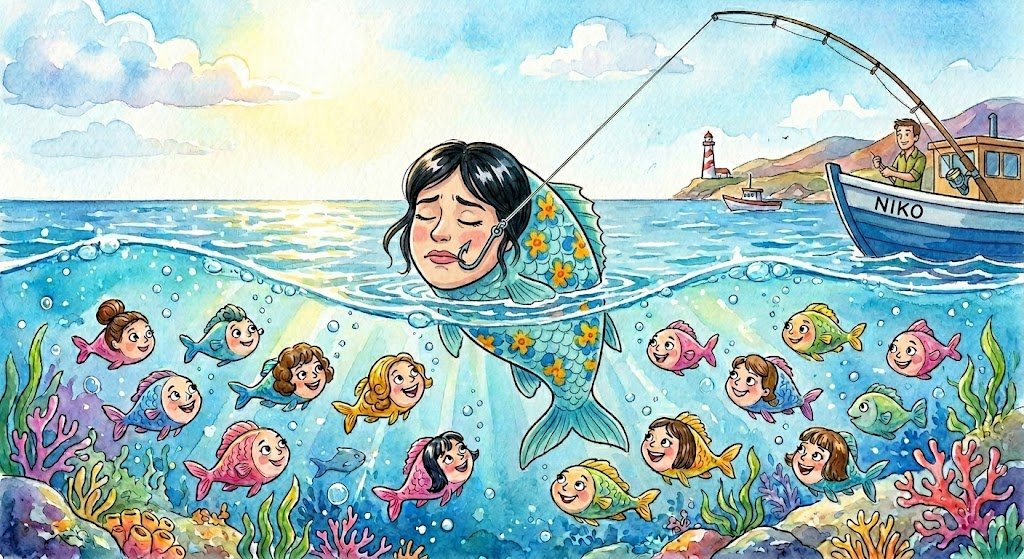
How I Built a Digital Trap to Catch a Poker Influencer Red-Handed
“I can’t even open my mouth to eat sometimes. It’s bad. It’s really bad. They don’t want you to know what happened to me. Three years of my life are gone.”
I. The Allegation
It’s March 29, 2023. 12:21 PM. A female poker influencer, Melissa Schubert tells tens of thousands of her followers she opened a hidden message folder and found hundreds of DMs from pro poker player Nikolaos Platis. “I didn’t even see these messages, this is so much worse than I thought” she writes. She characterizes him as a volatile schizophrenic, claims she is filing for a protective order that day. The poker world reaches a verdict on the man in minutes.
Three hours pass. At 3:50 PM, law enforcement receives a dispatch call. The podcaster files a report and sends the cops to his home under the assertion that the sender suffered from schizophrenia and possessed firearms. Both claims lack truth.
“I have never had schizophrenia, never in my life. I’ve never had a firearm ever. That’s a ridiculous load of crap. This [expletive] might’ve tried to kill me by cop,” Platis said.
Three separate clinical evaluations each show the same thing. Platis suffers from PTSD linked to this event, with zero symptoms of schizophrenia or any form of mental illness.
Nikolaos Platis was a full-time professional poker player for eight years. He’s logged more than a million hands and sat in live events up to the $10,000 level. He claims his career was put to an end because of this event stemming from a severe case of PTSD, and in part from his accuser leveraging her allegation and her influencer status to ban Platis from over 50 casinos including the WSOP.
“I feel like I’m in fucking Vietnam. I mean, people throw around the term PTSD when they lose money in crypto or something. That’s not what it is. It’s panic attacks that last days. I can’t do anything. I can’t even open my mouth to eat sometimes. It’s bad. It’s really bad. They don’t want you to know what happened to me. Three years of my life are gone. I can’t do my job. I can’t work. My future is gone. I promise you I’m telling you these people do not want you to know what’s happened to me.”
Platis admits he sent a high volume of messages. He disputes the allegations in full, claiming they are inconsistent, false, and taken out of context.
Melissa’s public account rests on a singular claim: that the podcaster freshly discovered the messages on that day March 29 2023.
The record contradicts this claim. The DMs spanned from November 9 2022 to January 3 2023. On December 5, 2022, right in the middle of that timeframe, she posted about those same DMs, joking about “a few people using my inbox as their daily diary.” In the same thread, she quoted Platis, indicating he was presently in her inbox. But on March 29, 2023 her story changed. “I didn’t even see these messages, this is so much worse than I thought,” she claimed.
II. The Plot Thickens
The December 5th tweet was just the first crack in the narrative. Behind the scenes, the dynamic between the two was far more twisted than a one-sided barrage sent into a void. Throughout the winter, Platis noticed she was using a veiled, passive responsiveness to breadcrumb him and take advantage of his desperation.
He would send her a direct message suggesting they play a cash game together; shortly after, she would post an Instagram story asking, “Why does nobody want to play cash with me?” He would send her a direct message with a song he wrote; she would post to her story with some generic song and the caption, “This song slaps.”
“I was so stupid. She was toying with me. It’s tough to prove what I’m saying outright. But I was there watching it happen for months she was messing with me on purpose she was breadcrumbing me,” Platis said.
To prove he wasn’t speaking to a wall, Platis laid a digital trap. He kept a pinned tweet on his profile specifically to monitor the incoming views every time he sent her a message. Over the course of the interaction, he meticulously captured 1,062 screenshots of these monitored page view counts.
When this massive dataset was fed into the AI model Claude Opus for forensic analysis, the results dismantled her story. The analysis found that it seems like Melissa was reading these messages in real-time, she was probably circulating them, and in all likelihood, she was responding but she hid it.
December 13: the line bends the moment the message sends
Cumulative impressions on the pinned tweet, 3am to 11am.
This is the strongest single instance. For five hours overnight the count crawls at 6 views an hour. Platis sends a message at 8:41am, and within minutes the line tilts to 70 an hour — an eleven-fold jump — then settles back. Someone went and looked, minutes after the message landed.
Across all messages, the lift is less pronounced but real
Average view rate in intervals after a message vs. intervals with zero messages.
Pooling every interval across six weeks, traffic ran 45/hr after a message versus 38/hr with zero messages. A genuine difference, but a modest one — not the ten-fold gap the highlight cases show, but the dramatic jumps are real.
Nine times the jump was clean and sharp
Baseline rate before, versus the spike rate right after a message.
These are the instances that survive scrutiny — a low baseline, then a clear multiple-fold jump within minutes of a message. As a set of striking coincidences, this is the real evidence. Each one traces back to specific screenshots.
The data strongly suggests she was watching him the entire time. But what came next is even crazier.
III. The Shadow Campaign
To the public, Platis was characterized as a delusional predator, but the details told a different story, and Platis never stopped trying to tell that story. The more he tried, the more resistance he met, but that didn’t stop him.
What followed in the dark was an asymmetric campaign of targeted hostility. Beginning in May 2023, about a month after Melissa’s allegation, and spanning over the following three years, a shifting network of more than forty anonymous accounts pursued Platis. The network utilized identity impersonation, intimidation tactics, extortion attempts, antisemitic tropes, and a forged death threat fabricated and circulated in his name. It utilized direct messaging insisting he jump from a balcony, or stating the only path to justice required ending his life.
This campaign operated under the assumption of anonymity. It was a predictable pattern. Platis would try to shed light on what happened to him, and there they were to try and shut him down, for 3 whole years. But they slipped up.
Based on the mechanics of social media, the sequence of events captured in the following screenshots presents a statistical anomaly. When analyzing digital footprints to determine if two accounts belong to the same user, investigators look for “bridging events”—moments where the operational firewall between a main profile and a burner account breaks down due to human error. This incident fits the exact profile of a bridging event. Here is the analytical breakdown of why the probability of these two accounts sharing an operator is overwhelming.
A burner account exposes its operator
Two minutes separate a notification sent to the main profile and a reply from the anonymous harasser.
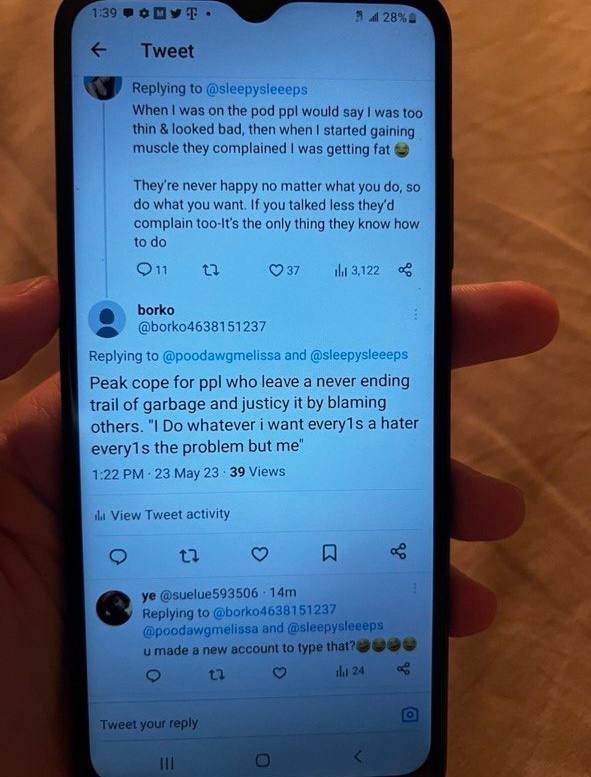
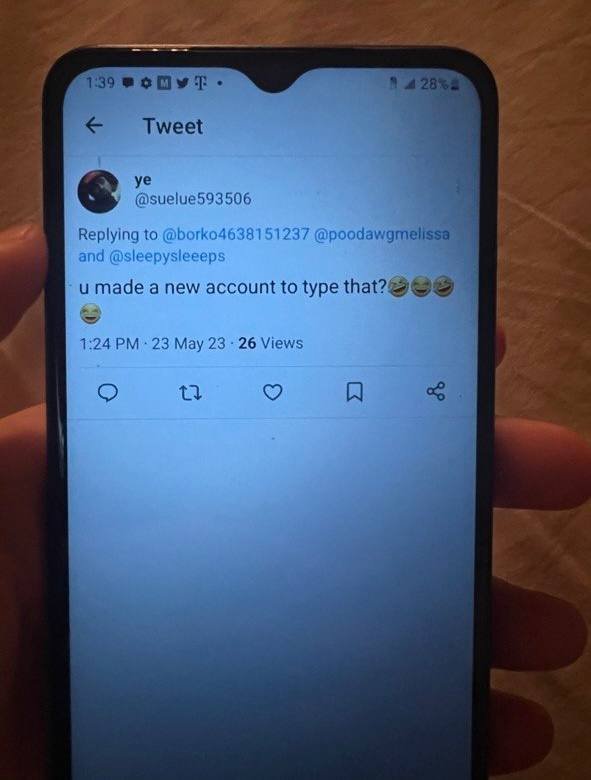
The timestamps capture a 120-second window. Digital investigators classify this as a temporal correlation — a catastrophic OPSEC (Operational Security) failure where the firewall between a main account and a burner account breaks down due to human error.
1. The Discovery Anomaly
According to reports, borko was a fresh account made by Niko Platis on that afternoon. It had zero footprint, zero followers, no posts, no likes, and the only person in the world who knew it existed at that time? Niko himself. The algorithm denies distribution to zero-engagement accounts. The post was not a top-level tweet; it was a reply to a reply. The only people who receive a direct push notification or an alert in their “Mentions” tab for that specific post are the users tagged in it: `@poodawgmelissa` and `@sleepysleeeps`. For an unaffiliated troll to find this nested reply without a notification, they required manual refreshment of the exact thread between `@sleepysleeeps` and `@poodawgmelissa` at that exact minute.
2. The Speed Anomaly
The timestamp of the “borko” post is 1:22 PM. The timestamp of the “suelue593506” response is 1:24 PM. A two-minute window eliminates the possibility of organic discovery by a third party. Two minutes is the precise time required to receive a push notification on a primary account (`@poodawgmelissa`), read the message, recognize the author, switch profiles on a mobile device to a burner account (`@suelue593506`), and type a response.
3. The Attribution Anomaly
The text of the “borko” tweet criticizes the recipient for leaving a “never ending trail of garbage” but conceals the identity of the author. The troll account replies in two minutes, “u made a new account to type that?😂😂😂😂”. If the troll’s only job up until this point was stalking the primary `@Niko_Platis` account, they possessed zero reasons to monitor Melissa’s nested replies. Should they stumble upon it, they lacked a method to deduce this random “borko” account belonged to Platis making a “new account.” The single person equipped to deduce that “borko” was Niko Platis is the person holding the historical context of his specific writing style and conflict: Melissa.
The Conclusion
The circumstantial and technical evidence pushes the probability of shared ownership into the 99 percent range. Platform mechanics dictate the operator of the @suelue593506 account held notification-level access to the @poodawgmelissa account. In digital investigations, an anonymous burner reacting to a private notification sent to a main profile within 120 seconds provides the temporal correlation needed to establish shared ownership.
“I mean, who else do you think it could be, Phil Ivey? It’s like they were playing whack a mole for 3 years whenever I tried to tell anybody what happened to me. I’m not saying she was behind all of it. But that account, on that day, at 1:24pm, it couldn’t be any clearer that it was her.”
This disconnect between public claims and digital reality extends into the courtroom. On June 8, the influencer filed an application for a protective order. She submitted a message from an anonymous account, @chubbycuppycake, attributing it to Platis and citing it as a source of her terror. Four days after filing the application, on June 12, the @chubbycuppycake account remained unblocked and left a critical remark on one of her posts. She replied directly to her alleged stalker with a public taunt: “There there, it will be okay.”
Four days after filing for a protective order, the podcaster responds to the account publicly.
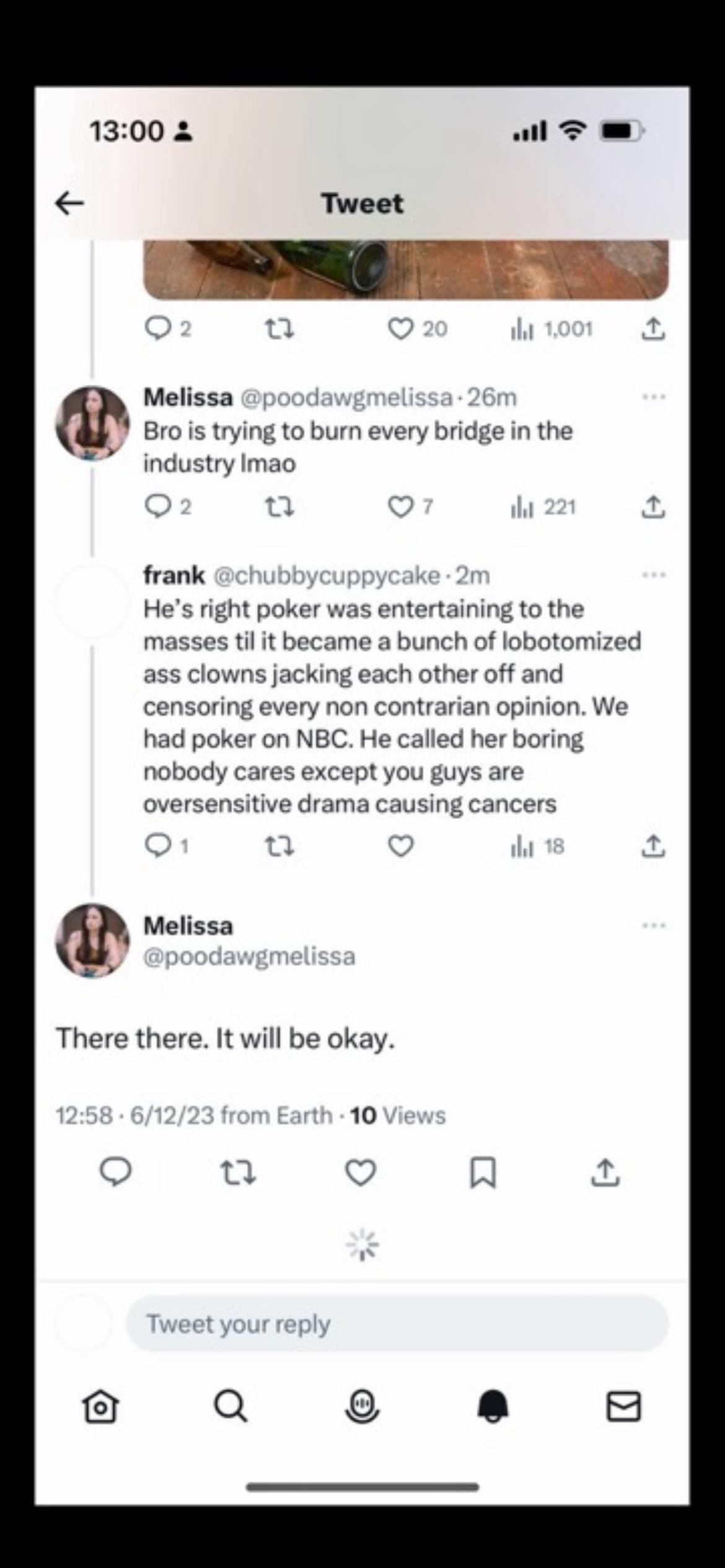
A public taunt. The screenshot captures the influencer replying directly to the @chubbycuppycake burner account — an interaction she later lied about under oath.
Later that month, she took the stand. Under oath, she swore she hadn’t interacted with him or responded after being asked by the judge. She claimed she was terrified he would climb through her window and dismember her. A plaintiff testified to fearing imminent bodily mutilation from a stalker, while the digital footprint shows her mocking the exact account she reported days prior. The sworn testimony is that of a victim; the behavioral record captures someone playing a game.
IV. The Aftermath
While the harassment operated in the shadows, the public allegations systematically dismantled Platis’s life. Before this, Platis had a career he worked over a decade on. For eight years he supported himself on poker, with zero safety nets — grinding online tournaments around a $170 buy-in, playing cash online, and sitting in live events up to the $10,000 level. He played the World Series Main Event six times. He is thirty-three years old. The game was his full time job and it worked for him.
“Working whenever I want, playing cards for a living, that was important to me. In that aspect I was at the top already because I had something most people don’t. I was not the best but I was able to make $50-$60k a year doing something fun and that was fine for me. All that was stolen from me. And they want to kill me to hide it. Does that sound fair? It sounds like cheating to me. It sounds like cheating. It sounds like I’m being cheated out of my life.”
The timeline reveals a direct collision. Around the time the podcaster published the allegations, Platis had initiated a new staking agreement. The contract provided capital and a clear path to high-stakes games. He possessed a proven strategy: log the volume, execute the process, collect the money and advance.
The publication dismantled the plan. For six weeks, Platis experienced recurring panic attacks. He logged fifty total hours over two months. The backer transitioned from an investor to a lender. Debt replaced profit. Platis eliminated the financial deficit by the end of the summer, but the backer terminated the arrangement citing Platis as a liability.
“I’ve been staked by nearly a dozen players. And this right here, was probably the best stake I ever got of my life. Access to the biggest games there are, and I just had to bunker down and climb up the stakes. Poof. Gone.”
A false allegation erased a prime career opportunity. It inflicted permanent injury and triggered a cascade of ruin.
The poker media and the influencer network observed the destruction. They compounded the damage. They watched the target bleed out as he contested the allegations.
The price ran in two directions. The earnings lost run past $200,000. His family spent $40,000 keeping him afloat. “My past, my present, and my future got taken at the same time,” he says — the years of work gone, the road ahead closed off.
Over 3 years later, now June 2026 and Platis is still being punished for something he never got the chance to contest. Platis claims he’s reached out to over 60 separate influencers to try and get a neutral look at his side.
V. The Coda
What was the reality of the hundreds of messages that Platis sent? In sworn testimony, Platis detailed the true motive behind his winter campaign: an attempt to intervene in a life-threatening crisis following the catastrophic FTX market crash.
“I thought her life was in danger from suicide, I went on her page and saw some stuff at the time, it seemed like a lot was going wrong for her; I believed I would be able to cheer her up.”But he is also candid about the dual nature of his persistence.
“I was thinking about myself, and my family too; this woman had a lot of opportunities around her. I thought it could be pretty good for me too. Both of these things were at play.”
For years, Platis operated with a behind-the-scenes approach to the people around him. He applied that instinct, launching a digital intervention designed to keep her anchored and alert. An act of intervention became a weapon. The profile broadcast to the public stripped the context and returned it as a threat.
“I do shit like that all the time. Knowing me, it probably worked. Look how I got repaid.”
How he was repaid exposes a fatal flaw in the ecosystem. Poker operates without an institutional governing body, a union, or an HR department. In this vacuum, self-appointed gatekeepers seize control, posturing as the moral guardians of the community. But without checks and balances, these actors trip over their own egos and political alignments, driving the community toward self-destruction. In an environment that is 96 percent male, the optics of protecting a female influencer became more valuable to them than the objective truth. They favored a woman simply because she is a woman, ignoring the facts entirely. By shielding an aggressor under the guise of defending a victim, they weaponized the exact protections they claim to uphold—proving exactly why their unchecked power must be dismantled.
When a specific group holds special advantages, the structure leaves room for them to cheat. That is the reality of what happened to Platis. A favored influencer received credibility, the platform, and the crowd. Platis received a verdict. The imbalance hands an aggressor a pass to cheat and to continue the abuse with zero reprieve.
The environment lacks checks and balances. It lacks fairness. It lacks a formal system. Poker players have few to none institutional protections to begin with. If players faces erasure based on singular, untested claims from these guys who like to play favorites, the average player is at a huge disadvantage.
The people responsible for the silence act as the enablers. The media refused to examine the contradictions. The gatekeepers spent three years giving Platis the silent treatment. When Platis attempts to present the evidence to third parties, a network of friends intercepts the communication. They justify the interference as a required measure for safety. The language of protection is weaponized to enforce censorship, to maintain the upperhand for themselves.
“I know their whole playbook. I know what they’re going to do if they’re on the spot for this. If I have 99% evidence for my side they’ll say, ‘Well what about the 1% you’re wrong?’ If they have 1% evidence against me they’ll try to use it against me. And if I’m right beyond a doubt they’ll try and cite something else: ‘Well you did get cheated out of $13 million but you’re being rude so everything’s your fault.’ They’re always going to find a few people to believe them. That’s kind of what social media has been. It’s a complete one-way street for these people. They are social cheats. I know what they are. It’s time for you to know too.”
The transfer of power happens the moment an audience looks at the facts. A fabricated narrative lacks the capacity to function in the open. The media chose silence.
“People need to know what happened to me. Three years of my life are gone. I want to get unbanned from the WSOP, I want to raise money for my lawsuit, I want the people who did this to me to be caught and to be served justice. None of that can happen if nobody knows what’s going on, if nobody’s allowed to think for themselves.”
These actors work from the shadows, but darkness disappears in the light. That’s what this requires, is to expose the facts, and most of their power is gone. Like a cheated game, once people know, it’s over.